
When AI Doesn’t See What Your Beauty Brand Sees
AI may not be misunderstanding your beauty brand. It may be accurately reading an incomplete public version of it.
Inside the company, the positioning is precise. The team knows why the product is different, who it is for, what the formulation does, and how the packaging, photography, language and product architecture express that idea.
Then the brand leaves an environment it controls.
On a retailer PDP, a carefully developed treatment becomes “hydrating serum.” A scalp system built around a particular consumer problem becomes “hair growth.” A foundation developed around a specific relationship between coverage, finish and skin behavior becomes “medium coverage.”
None of those descriptions is necessarily wrong. But each has lost some of the reason the company believes the product should be chosen.
This is where we play dumb.
We look at the brand without the strategy presentation. We search the category, open the retailer page, read the reviews, examine the editorial coverage and document what a customer can actually see.
If a customer doesn’t see it, it doesn’t exist.
AI raises the stakes of that exercise because it can now assemble an interpretation of the brand from those same public fragments before the customer ever reaches the brand’s own environment.
AI is assembling the brand from the pieces it can find
This question became more consequential while MSLK’s Managing Director, David Van Veen, was speaking with WWD for its feature Beauty Discovery in the Age of AI.
The article examines L’Oréal’s work with OpenAI, including a U.S. pilot supplying verified product information for Lancôme and Kérastase to ChatGPT. David discusses another part of the shift: the importance of establishing meaningful associations across the digital environments AI encounters and the growing overlap between PR and search.
What interests us is what sits underneath those developments.
Companies have always distributed pieces of their brands into environments they do not completely control.
Retailers rewrite product descriptions. Editors characterize brands in their own language. Customers emphasize unexpected benefits in reviews. Creators demonstrate products according to their own experience. Search engines determine which competitors appear beside them.
Historically, the brand’s own environment could do much of the work of putting those pieces back together. What MSLK has long called 360° Branding allows positioning, identity, packaging, product education, merchandising and commerce to reinforce the same underlying meaning, even when each expression performs a different job.
AI increasingly has the potential to form an interpretation earlier.
That makes what survives outside the branded environment more consequential.
The brand is usually clearest where the company has the most control
A beauty product can feel unusually distinctive on its own website because many signals are working simultaneously.
Photography creates desire. Packaging communicates category and value. Language establishes expertise. Product architecture creates relationships. Editorial content explains the philosophy. The surrounding visual system tells the customer how the product should feel before she has touched it.
Remove those signals and some brands remain remarkably specific.
Others become interchangeable very quickly.
That difference is worth examining.
Beauty cannot be reduced to a database of product attributes. Ritual, identity, aspiration, sensation and aesthetic meaning are part of why people care about the category in the first place.
But the atmosphere cannot be responsible for all of the differentiation.
A barrier treatment needs something more defensible underneath it than looking more clinical than the other barrier treatments.
A luxury moisturizer cannot depend entirely on photography, typography and price to explain why it belongs in a customer’s life.
A hair product designed around a particular texture, styling behavior or problem should retain some trace of that specificity when it reaches a retailer, search result or recommendation.
If removing the branded environment also removes the reason for choosing the product, AI may not be creating the weakness.
It may simply be making it easier to see.
The expression can change. The meaning has to survive.
Consistency is frequently mistaken for repetition.
The retailer page should not read like the campaign. An editor should not sound like the brand copywriter. A dermatologist, creator, and customer will naturally describe the same product differently.
Trying to impose identical language everywhere would make the brand less credible, not more.
What should remain coherent is the meaning underneath those expressions.
If a product is genuinely differentiated by the customer it serves, the problem it solves, a particular formulation, an application behavior, a ritual or the circumstances in which it performs especially well, those associations should be able to travel.
The retailer may compress them. Editorial coverage may place them into a larger category of conversation. Customers may express them in language the company would never have written itself.
The words change because the context changes.
The reason for choice should still be recognizable.
This is one reason customer language plays such an important role in MSLK’s research. We compare how brands describe themselves with how people actually search, review, compare and talk about the category.
The objective is not to replace distinctive brand language with keywords. It is to understand whether the meaning the company wants to own has actually made its way into the market.
Sometimes consumers clearly understand the differentiation but describe it in language the company has never considered strategically important.
Sometimes the company repeats a positioning idea constantly and we find very little evidence that the association has escaped its own channels.
Those findings lead to very different decisions.
AI gives us another place to observe them.
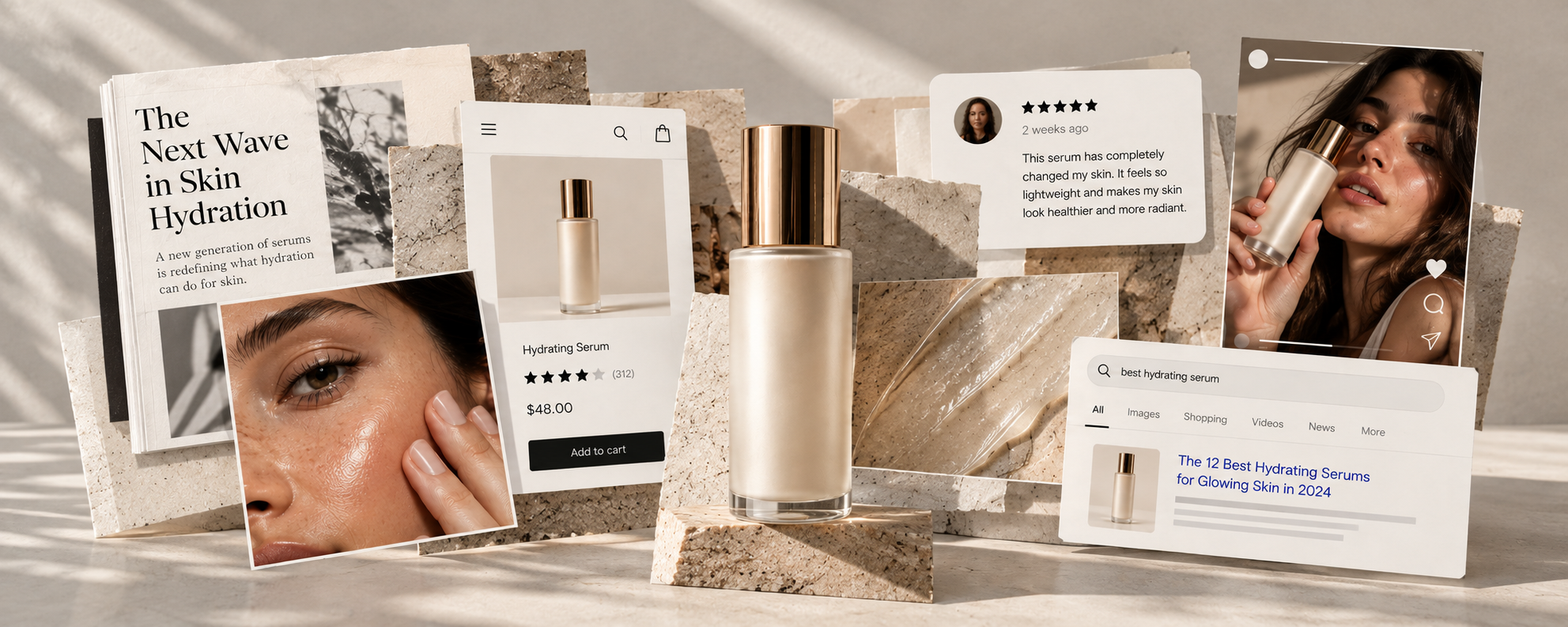
The customer never saw the organizational boundaries
Inside a beauty company, brand, e-commerce, retail, PR, SEO, and social may belong to different teams, budgets, and agencies.
That separation can make operational sense. It has never existed for the customer.
AI makes it even less meaningful at the point of discovery.
Editorial authority, retailer language, product information, customer reviews and search content may have been created for different reasons, but they can all contribute to the same interpretation of what a brand is associated with.
This is what makes David’s observation in WWD about PR and search converging more significant than a change in channel tactics.
The company can continue organizing these functions separately.
The meaning they put into the market cannot afford to be accidental.
More content is not automatically more clarity
There is an obvious response to all of this: produce more.
More product descriptions. More FAQs. More articles. More structured data. More retailer content. More AI-oriented copy.
That may increase the amount of information surrounding a brand. It does not necessarily make the brand easier to understand.
If the company has not decided what a product should credibly be known for, additional content can simply distribute the ambiguity more widely.
The work begins earlier: with a specific relationship between the product and the customer, proof strong enough to support it, and an understanding of how customers actually describe the benefit.
Then distribution can compound meaning rather than dilute it.
For beauty brands, the challenge is doing that without flattening everything emotional, sensorial or distinctive about the category into machine-readable claims.
A brand should not invent exaggerated use cases because they might make useful AI prompts. It should not turn incidental customer comments into unsupported product claims. And it should not surrender its emotional positioning simply because functional information is easier to categorize.
Precision should make the brand more legible, not less human.
Looking for a Beauty Branding Agency?
MSLK is a 360-degree branding partner for beauty and wellness. Strategy, packaging, and marketing — built to help brands stand out.
AI gives brands another place to play dumb
One of the most useful things we do when evaluating a brand is deliberately forget what we know about it.
We call it playing dumb.
Look at the retailer shelf without the strategy presentation. Search the category without beginning with the brand name. Read the product page without knowing what the formulator intended. Look at what customers repeat in reviews and which competitors the market places beside the product.
Then document what is actually there.
AI can be approached the same way.
Start with the consumer problem rather than the brand. Observe whether the brand appears, how it is characterized, which companies surround it and what evidence seems to be shaping the answer.
Sometimes the result reflects the positioning remarkably well.
Sometimes a differentiator that occupies enormous internal attention barely exists outside the company’s own site. Retail partners may have flattened the language. Customers may have established a different use case. The brand may be consistently compared with companies nobody internally considers competitors.
Those are not all AI problems.
They are evidence that something between the brand’s intended meaning and its public expression deserves closer examination.
The answer may involve product information, retailer content, search, PR, customer education or stronger proof. Occasionally, it reveals that the positioning itself needs more precision.
The first job is knowing which problem you actually have.
MSLK’s Shelf-to-Shelf Beauty Brand Audit looks at the brand from the outside in—examining how positioning, messaging, packaging, retail, digital experiences, search, and other customer-facing expressions reinforce or weaken the meaning the brand intends to own.
AI can now be one of those environments.
Want To See More Content About Business of Beauty?
Stay up to date with expert information on the ever-evolving beauty industry. We share the best practices brands are using to connect with consumers in new and meaningful ways.
More Like This

The AI Beauty Shelf Is Getting Smaller. The Consumer Question Is Getting More Specific.
Beauty brands have spent years thinking about digital visibility as a ranking problem. Get onto page one. Move higher in ...