
The AI Beauty Shelf Is Getting Smaller. The Consumer Question Is Getting More Specific.
Beauty brands have spent years thinking about digital visibility as a ranking problem.
Get onto page one. Move higher in the results. Earn the click before someone else does.
AI changes something more fundamental than the ranking.
It reduces the shelf.
When a consumer asks an AI platform for a recommendation, the answer may contain only a handful of products. There is no guarantee of a second page. A brand can disappear from consideration before the consumer ever reaches its website.
That was the concern behind a recent eMarketer conversation with MSLK Managing Director David Van Veen, who described visibility in unusually stark terms: “If nobody sees it, it doesn’t exist.”
For indie beauty brands, the immediate conclusion is uncomfortable. Large companies enter this environment with enormous advantages. They have years of retailer listings, reviews, editorial coverage, creator mentions, marketplace presence and other signals distributed across the web.
But there is another behavior at work in beauty that makes the outcome less predetermined.
Beauty consumers rarely stop at the first question.
Beauty shoppers keep narrowing the brief
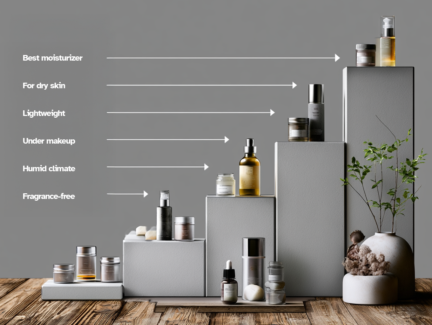
A consumer may begin by asking for the best moisturizer.
That question is broad enough to favor brands with broad recognition.
Then she adds that her skin is dry. She wants something lightweight. She wears foundation over it. She lives somewhere humid. She dislikes fragrance. She wants to stay below a particular price.
The competitive set has changed.
The same thing happens across beauty.
A search for sunscreen becomes a search for sunscreen that works on deeper skin tones, under makeup, without pilling.
A foundation search acquires requirements around finish, coverage, undertone, mature skin, sensitivity and wear.
A shampoo recommendation changes once hair texture, scalp condition, styling habits, color treatment and climate enter the conversation.
This has always been how people buy beauty. AI simply gives consumers a new way to articulate those qualifications quickly.
David described the opportunity to eMarketer as a “quantity of specificities.”
The phrase is useful because it points toward a different kind of competitive advantage.
An indie brand does not need to become more famous than the category leader for every consumer.
It needs to become more relevant as the question becomes more precise.
Specificity cannot be manufactured by content volume
There is an obvious way for marketers to ruin this opportunity.
Take every possible skin concern, ingredient, demographic, routine and occasion. Combine them into hundreds of keyword variations. Generate a page for each one.
The result would be more content. It would not necessarily produce a better understood brand.
Useful specificity starts much closer to the product.
What do customers repeatedly notice after using it? What questions appear in customer service? What do reviewers describe without being prompted? What prevents someone from purchasing? Which products do consumers compare it against? Where in the routine does confusion arise?
A sunscreen that repeatedly earns praise because it sits unusually well beneath makeup has something worth investigating.
So does a cleanser consumers keep recommending to people who dislike the tight feeling associated with the category.
So does a hair product being used successfully in a way the original marketing barely acknowledges.
These observations are more valuable than an invented list of long-tail keywords because they reveal where the product already has a credible right to compete.
At MSLK, this is one reason we place so much emphasis on customer language. We compare how the brand describes itself with how consumers actually search, review, speak and think about the category. Our rapid consumer research process starts by gathering fragments from throughout the brand and the market, then examining how those fragments appear in search behavior.
We are looking for more than volume.
We want to know what is top of mind when consumers enter the territory, where their language diverges from the brand’s, and which combinations reveal an unmet or underdeveloped need.
The marketing can then become more precise because the understanding became more precise first.
AI makes a brand’s entire digital footprint part of the answer
For years, many brands treated their website as the definitive version of themselves online.
AI makes that increasingly difficult.
A brand may describe a product one way. Retailers describe it another way. Customers introduce language the brand never considered. Creators demonstrate uses that are barely mentioned on the product page. Publishers place the product in competitive sets the brand may or may not have intended.
All of those environments contribute to the digital record surrounding the product.
David noted in eMarketer that retailer and marketplace presence can provide smaller brands with additional leverage because each creates another digital ecosystem in which the brand can be understood.
This makes consistency more important, but consistency should not be confused with repeating the same sentence everywhere.
A retailer, dermatologist, creator and customer should not sound like the brand’s copywriter.
The stronger signal is agreement about what the product actually does, who finds it useful and why.
A creator demonstrates that a sunscreen disappears cleanly on deeper skin. Reviews repeatedly confirm it. The retailer provides accurate finish and application information. The product page explains the formulation clearly. Editorial coverage places it within the same use case.
Different sources are contributing different kinds of evidence.
The meaning holds together.
That is considerably harder to manufacture than message repetition.
It is also closer to how we already evaluate brands at MSLK. We rarely look at a brand only through its own website. We “play dumb” and encounter it as the customer does: in Google, on retailer shelves and product pages, in reviews, on social platforms, on Amazon and wherever else the decision is actually occurring.
The competitive set changes in each environment.
Increasingly, AI is becoming another one of those environments.
The product page becomes more important after AI, not less
There is a tendency to imagine AI eventually answering enough of the consumer’s questions that she no longer needs the brand website.
Beauty does not behave much like that.
A shopper considering foundation may still want swatches, finish, coverage, application guidance, undertones, ingredient information, reviews and comparisons. A skincare consumer may want to understand compatibility with the rest of her routine. Someone buying haircare may need much more context than a recommendation engine can reasonably fit into a short answer.
This is one of beauty’s structural advantages.
AI can narrow the field without necessarily completing the decision.
That gives the product page a different job.
It no longer needs to merely attract the initial search. It needs to reward the consumer who arrives with a much more developed question.
This favors depth, but only useful depth. Longer pages filled with positioning language are not inherently more persuasive. The value comes from anticipating the questions that stand between interest and confidence.
One of the first things we look at in a digital audit is whether the information hierarchy reflects what the customer actually needs to decide.
Brands often know far more about themselves than customers do. Internal teams have heard the positioning hundreds of times. They know the product architecture, ingredient stories and claims by memory.
The customer arrives knowing none of it.
If she cannot see the information she needs, the fact that the company knows it is irrelevant.
If a customer doesn’t see it, it doesn’t exist.
The best product pages increasingly resemble the knowledge of an exceptional beauty advisor: specific, practical and aware of the conditions that change the recommendation.
AI will expose poorly defined brands
There is a larger brand problem hiding underneath the discussion about AI visibility.
Many beauty brands are still difficult to describe without resorting to the same vocabulary as their competitors.
Effective. Clean. Elevated. Science-backed. Luxurious. High-performance. Inclusive.
Those words may support a brand story. They rarely explain why one product belongs in a recommendation and another does not.
Search engines gave vague brands considerable room to compensate. Paid media could generate traffic. Retail placement created discovery. Beautiful imagery earned attention. A consumer could encounter the brand repeatedly before fully understanding what distinguished it.
AI-mediated discovery may be less forgiving.
When a system is asked to compress a category into several recommendations, a brand with a clear relationship to a particular consumer need is easier to explain than one whose differentiation depends mostly on atmosphere.
This does not diminish branding. It raises the standard for it.
A strong beauty brand still needs emotion, identity, aesthetics and cultural meaning. But underneath that world must be something surprisingly concrete: a clear understanding of when this product should be chosen.
MSLK’s broader brand philosophy starts from a similar premise. A strong position articulates something meaningful the customer already wants, believes, feels or is becoming, then gives that desire a credible home in the complete brand system.
AI creates another test of that coherence.
If a system had one sentence to explain why a product belongs in a shopper’s consideration set, would that sentence contain a meaningful distinction?
And when the shopper clicks through, would the packaging, product experience, education, reviews and broader brand world reinforce it?
The machine may shorten the story.
It also makes inconsistency easier to see.
Looking for a Beauty Branding Agency?
MSLK is a 360-degree branding partner for beauty and wellness. Strategy, packaging, and marketing — built to help brands stand out.
The opportunity is to become more knowable
Large beauty companies will retain many advantages in AI discovery. Their visibility across retailers, publishers, reviews and the wider internet is real, and no optimization tactic makes that disappear.
Indie brands should resist responding by trying to imitate that scale.
The more useful goal is to become exceptionally well defined.
Know the situations in which the product performs best. Understand how consumers actually describe those situations. Answer the questions that emerge as consideration becomes more serious. Make sure the brand’s website, retailers, creators, publishers and customers provide enough coherent evidence for those associations to hold.
Then look at the result from the outside.
Ask an AI platform about the category. Ask about the problem your product was designed to solve. Keep narrowing the question the way a real beauty consumer would.
Do not search for your brand.
See which brands appear.
Look at how they are described. Notice which competitors enter as the question becomes more specific. Examine what the system appears to understand about your own brand and, equally important, what it does not.
The gaps can be revealing.
A brand may discover that its strongest differentiator barely exists outside its own website. Retailers may be describing the product too generically. Consumer language may point toward an opportunity the brand has never developed. The market may associate the company with a benefit its own positioning barely acknowledges. Or the brand may lack enough credible third-party evidence to support a use case it believes it owns.
This is where AI visibility becomes a strategic diagnostic rather than another content tactic.
MSLK’s AI Visibility Audits examine how a beauty brand appears across AI platforms, traditional search and the broader digital ecosystem. We look at what the systems understand about the brand, which competitors are being surfaced, where the brand’s own language diverges from customer language and where authority or evidence is missing.
The work does not stop with an audit.
Because MSLK works across brand strategy, SEO, content, digital, retail and PR, we can address the underlying reason the brand is difficult to retrieve or recommend—whether that requires clearer positioning, stronger product information, different search content, retailer alignment, third-party authority or a broader proof network. That connection between AI visibility, SEO and PR is already central to how MSLK approaches discoverability.
AI may be shrinking the number of brands a consumer sees at any one moment. At the same time, consumers are becoming more capable of describing exactly what they want.
For indie beauty brands, those two forces are not necessarily in conflict.
The broadest shelf belongs to scale.
The increasingly specific question may still belong to the brand that understands its customer best.
Want to know what AI thinks your brand is known for—and whether that matches what you want to be known for?
Request an AI Visibility Audit
Want To See More Content About Business of Beauty?
Stay up to date with expert information on the ever-evolving beauty industry. We share the best practices brands are using to connect with consumers in new and meaningful ways.