
Who Are Your Competitors? Well, It Depends…
Ask a founder who their competitors are and you will usually get a tidy list of brands.
The list is often wrong.
Founders tend to name brands they admire, brands they resemble, brands selling similar products, or brands they would like customers and investors to compare them with.
Those brands may be useful references.
They are not necessarily the alternatives competing for the decision the company actually needs to win.
At MSLK, we approach competitive analysis from the decision outward.
Who needs to choose you?
What are they trying to accomplish?
What else could they reasonably choose instead?
For a customer, that might mean another product, another category, a dermatologist, an esthetician, an at-home remedy or simply doing nothing.
For a retail buyer, the competition may be every brand capable of filling the same role in the assortment.
For an editor, it may be every other product, founder, launch, trend or industry story competing for attention that week.
Those are very different competitive environments.
And a useful competitive audit should help you succeed in all of them.
The customer changes your competitive set every time she changes environments
Consider a skincare brand.
Put the product in Sephora and its competitive environment is partly defined by the products surrounding it, the categories Sephora places it within, the claims customers see and the recommendations made by associates.
Put the same product on Amazon and the environment changes.
Search results, reviews, sponsored placements, price, availability and a much larger field of visually similar alternatives become part of the decision.
Move the customer to Google and the competitors change again.
She may encounter editorial articles, Reddit discussions, dermatologist advice, retailer pages, ingredient explainers or brands she has never encountered in retail.
TikTok may produce another set entirely.
We see substantial variation between these environments.
That makes the traditional exercise of selecting five competitors and studying them exhaustively surprisingly limited. You can know those five brands extremely well while missing much of the market your customer actually experiences.
When we conduct competitive research, we spend less time trying to establish one definitive list and more time understanding what is happening in the places where the customer actually makes decisions.
Who keeps appearing?
What information is repeatedly being shown?
What has become table stakes?
Where are brands doing something meaningfully better?
What is conspicuously absent?
A brand appearing across several important environments deserves particular attention. But where the competitive sets diverge, forcing them into one master list often removes useful information.
“Play dumb” is one of the most useful things we can do
Internal knowledge creates a disadvantage during competitive research.
The founder already understands the category.
The marketing team knows what the product does.
Everyone knows which claims matter, why the formulation is different and which brands the company considers comparable.
The customer does not begin with any of that information.
So we deliberately try to remove it.
We play dumb.
If I were this customer and had this problem, what would I do?
What would I type into Google?
What would I see at Target?
What changes if I walk into Sephora?
What does Amazon place around the product?
What solutions does social media put in front of me?
What language keeps appearing?
What seems credible?
What would I reasonably consider doing instead?
This sounds simple. It is difficult to do well because everyone inside the company has spent months or years accumulating information the customer may encounter for the first time in thirty seconds.
Competitive analysis becomes more useful when we temporarily stop evaluating the category as industry experts and experience it as the customer does.
Sometimes your competitor is not another brand
This becomes especially important as products move upmarket.
A prestige skincare treatment may compete with another prestige treatment.
It may also compete with an esthetician.
A clinical hair product may compete with a professional service.
A product built around avocado, argan or another familiar oil may compete with someone buying the raw ingredient and creating a much simpler at-home ritual.
Customers are under no obligation to respect the category architecture the beauty industry has created.
They have something they want solved.
They consider available ways of solving it.
The useful question therefore becomes:
What else might this particular customer do instead?
That still requires discipline.
If the problem is simply “I have acne,” the competitive field is almost uselessly large. The target customer narrows it.
Her budget narrows it.
Her level of sophistication narrows it.
The severity of the condition narrows it.
Her willingness to visit a professional narrows it.
Her geography, shopping behavior and existing routine narrow it further.
The competitive set becomes useful when the customer, problem and circumstance become specific enough to produce actual choices.
Sometimes the most important competitive set belongs to one product
We also frequently narrow the exercise around the product responsible for bringing customers into the brand.
The hero SKU.
The entry product.
The product expected to fuel acquisition.
A company may have twenty products, but the commercially important competitive question may concern the first one a new customer encounters.
What is she comparing it with?
What alternatives appear beside it?
Which claims dominate that decision?
What would cause her to choose something else?
Looking at competition only at the corporate level can obscure this.
The competitor to your cleanser may not be the competitor to your moisturizer.
The product responsible for introducing thousands of new customers to the brand deserves a different level of scrutiny from a SKU primarily purchased by customers who already know and trust you.
Competition is partly a question of where the relationship begins.
A retail buyer has a different problem to solve
The customer is only one of the people who may need to choose the brand.
A retail buyer is making another decision entirely.
She is not simply asking whether the product is good.
She is deciding whether the product deserves space inside an existing assortment.
What role does it play?
What customer does it bring?
What demand already exists?
What does it add that the retailer does not adequately have?
Will it move?
Can the company support the launch?
What deserves to lose shelf space, inventory investment, merchandising attention or marketing resources in order to make room for it?
The competitive set changes immediately.
Your closest formula competitor may matter less to the buyer than another emerging brand addressing a more attractive whitespace opportunity.
This is especially relevant now. Beauty Independent reported in June that retail assortments have become tighter, merchant teams leaner and buyers more selective, while fundamentals such as clear positioning, strong products and evidence of consumer demand remain central to earning shelf space. Ulta’s current MUSE Accelerator, for example, specifically references sales growth, whitespace opportunity and community impact in evaluating participating brands.

So the competitive audit should inform the retail pitch.
Not simply:
Here is why we’re better than Brand X.
The more useful pitch is:
Here is the role we can play in your assortment.
Here is the customer opportunity.
Here is what she currently sees.
Here is where the existing assortment leaves something unresolved.
Here is the product that gives us the strongest entry point.
Here is the evidence that customers want it.
And here is what we can realistically do to help it succeed once you give it space.
That requires understanding the retailer itself as a competitive environment.
Sephora and Ulta can contain many of the same categories while rewarding different brands, price structures, messages and behaviors. Current market analysis has found meaningfully different haircare playbooks between the two retailers, with identity and premium positioning performing differently from performance claims, professional credibility and value.
Pitching the same competitive story to both can miss what each retailer is actually trying to build.
Looking for a Beauty Branding Agency?
MSLK is a 360-degree branding partner for beauty and wellness. Strategy, packaging, and marketing — built to help brands stand out.
An editor is choosing between stories, not serums
Media creates another competitive landscape.
An editor may receive dozens of skincare launches that all believe their principal competitors are other skincare brands.
From the editor’s perspective, those launches are competing with much more than skincare.
They are competing with a founder story.
A retail expansion.
A funding announcement.
A cultural trend.
A new technology.
A collaboration.
A category shift.
A story the editor already committed to yesterday.
The scarce resource is editorial attention.
This changes how we should think about PR.
An editor does not need another brand telling her it has launched an effective product with high-quality ingredients and beautiful packaging.
There is no shortage of those.
She needs a reason this particular brand contributes something to the conversation she is responsible for covering.
Recent beauty-industry PR reporting has also described a harder media environment for straightforward product-launch coverage, with greater emphasis in consumer commerce publishing on established hero products capable of producing affiliate revenue. Editors have long described the basic filter similarly: does the product or story have genuine coverage potential, does it connect to something relevant to the publication, and does the pitch provide useful information rather than merely asking what the editor is working on?
A competitive audit should therefore look at the media landscape as aggressively as it looks at the product shelf.
Who already owns the conversation around the problem?
Which founders repeatedly get quoted?
Which claims have become indistinguishable?
Which ingredients have been covered to exhaustion?
What cultural or business questions are emerging around the category?
Where does your brand have actual evidence, expertise or experience that adds something others cannot?
What could an editor say about you that she could not write just as easily about six other launches?
That is where competitive research starts informing the pitch.
You are no longer asking only:
How do we get press?
You are asking:
What story can we credibly contribute that the existing market has not already told?
That is a much better starting point for PR.
Buyers and editors are part of the customer journey
This may sound like we have moved away from the customer.
We haven’t.
Retail buyers and media editors shape what the customer eventually encounters.
A retailer decides what receives shelf space.
An editor decides what receives coverage.
A search engine decides what receives visibility.
A creator decides what receives attention.
Each one changes the environment from which the customer ultimately chooses.
We often tell clients:
If a customer doesn’t see it, it doesn’t exist.
Competitive analysis therefore cannot stop at understanding what customers prefer after products have already reached them.
It should also examine the gatekeepers and systems determining which products reach them at all.
That changes what competitive intelligence is for.
You are not merely trying to look different from other brands.
You are learning what must be true for the brand to keep earning consideration as it moves through different decision-makers.
The brands you admire may still be useful. Just don’t confuse them with the competition.
Founders understandably study successful companies.
A young fashion brand may study Chanel. An emerging skincare company may study Cerave.
There can be enormous value in this.
You can learn from visual codes, retail execution, product architecture, pricing, communications and operating behavior.
But the strategic problem that company is solving may bear almost no resemblance to yours.
Chanel and Cerave already have awareness.
An emerging brand does not.
An established brand may spend enormous resources maintaining status, serving existing customers and transferring accumulated meaning into new products.
A new company has to introduce itself.
Those require different strategies.
The danger arrives when the aspirational reference becomes the basis of the competitive strategy.
A founder sees what the established brand is doing and concludes:
We should do that.
The tactic is visible.
The conditions making the tactic effective are not.
Budget is different.
Distribution is different.
Awareness is different.
Authority is different.
Customer history is different.
Retail leverage is different.
Media interest may be different simply because one company is already culturally consequential and the other is asking the market to notice it for the first time.
The wrong competitors produce strategies you cannot execute
This is where a seemingly academic question begins creating commercial consequences.
Choose competitors with fundamentally different resources, audiences or problems and the competitive audit can recommend actions that make very little sense for your business.
You may imitate a brand whose primary challenge is maintaining status when yours is generating awareness.
You may copy a retailer strategy without its distribution.
You may emulate media behavior without having the story or authority that earns it.
You may imitate the communications of a company whose customers already understand the category while yours still require education.
The resulting strategy can look sophisticated while being impossible to execute.
For us, that defeats the purpose of competitive analysis.
A competitive audit should create decisions.
What appears to work?
What are customers being shown?
What are buyers already being pitched?
What are editors already covering?
Where are we below the standard the market has established?
Which conventions do we simply need to meet?
Where can we meaningfully outperform?
Where is there credible white space?
And which of those opportunities can this company actually pursue with the resources it has?
The answer may change from search to Sephora to Amazon to PR.
It should.
Competitive analysis should end in action
There may never be one perfect answer to “Who are our competitors?”
A competitor in paid search may not be your primary competitor at Sephora.
A facial studio competing for a customer within a twenty-minute drive can still learn from a national operator that will never compete for the same appointment.
A dermatologist can compete with a prestige treatment while simultaneously lending authority to the category that treatment occupies.
A beauty editor may compare your story with companies you would never place on the same competitive slide.
Different decisions require different comparison sets.
What matters is knowing why you selected them.
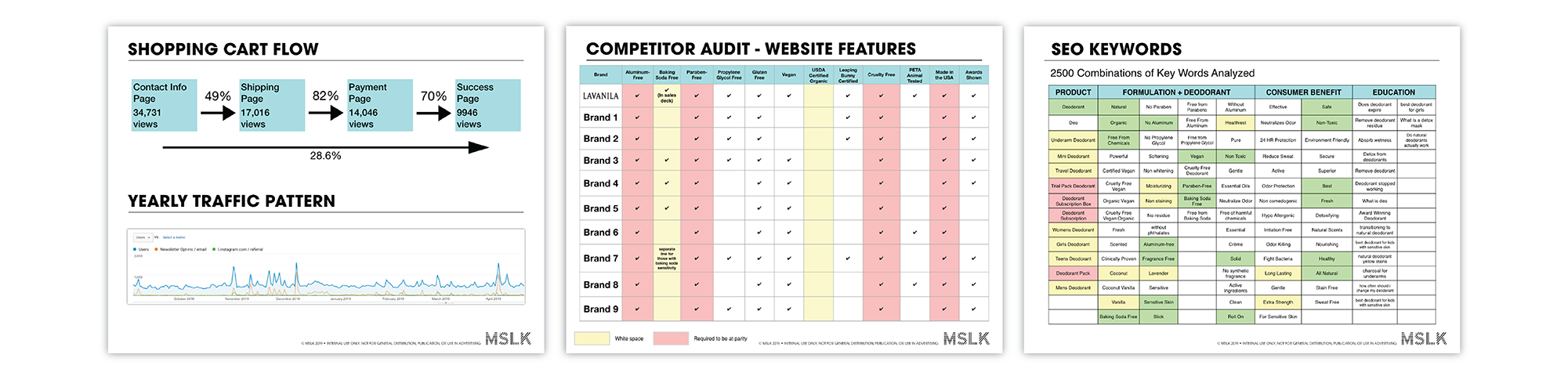
At MSLK, competitive analysis often sits at the beginning of larger brand and growth work. Our experience has included competitive analysis alongside brand and retail audits, with the findings then informing brand strategy, positioning, packaging, retail presentation, digital strategy and marketing.
Today that can extend further into SEO, content and PR, because search visibility, retailer language and third-party editorial authority increasingly affect whether a brand becomes part of the customer’s consideration set at all.
We do not conduct competitive audits to produce a collection of logos and observations.
We use them to determine where the brand is actually competing, what each important decision-maker needs, where the current system is weak, and which opportunities are realistic enough to act on.
Sometimes that leads to brand strategy.
Sometimes packaging or retail needs attention.
Sometimes the opportunity is search.
Sometimes it is PR.
And sometimes the analysis tells us the brand itself is fine and the constraint lives somewhere else.
The useful question was never simply:
Who looks like us?
It is:
Who else could win the decision we need—and what would give us a credible reason to win it instead?
MSLK helps beauty brands understand the competitive environments surrounding their customers, retailers, search visibility and media presence. Through competitive analysis, brand and retail audits, brand strategy, packaging, digital strategy, SEO and PR, we identify where the brand is meeting the market, where it is disappearing into it, and what deserves attention next.
Want To See More Content About Brand Strategy?
Stay up to date with expert information on the ever-evolving beauty industry. We share the best practices brands are using to connect with consumers in new and meaningful ways.